
Princess Beatrix Lock
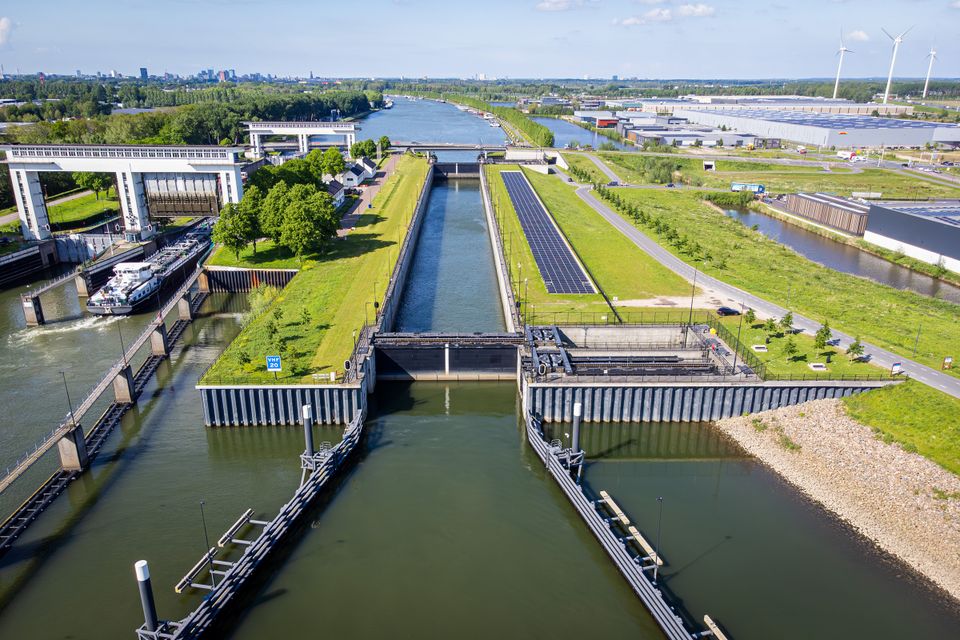

The lock complex at Nieuwegein has consisted of 3 gullies since 2019. Before then, there were 2. The original 1938 lock complex is a so-called twin lock. A middle head separates the east and west locks.
The white structure of the locks can be seen from afar. These are the white-painted reinforced concrete lifting towers, along which the lifting doors move up and down. The covered structure connecting the lift towers houses the machinery. This makes the lifting doors move up and down. On the outside are open, semi-circular balconies with an overhanging flat roof.
The 3rd lock chamber
The Princess Beatrix Lock is the main dire...
The lock complex at Nieuwegein has consisted of 3 gullies since 2019. Before then, there were 2. The original 1938 lock complex is a so-called twin lock. A middle head separates the east and west locks.
The white structure of the locks can be seen from afar. These are the white-painted reinforced concrete lifting towers, along which the lifting doors move up and down. The covered structure connecting the lift towers houses the machinery. This makes the lifting doors move up and down. On the outside are open, semi-circular balconies with an overhanging flat roof.
The 3rd lock chamber
The Princess Beatrix Lock is the main direct waterway link between the ports of Rotterdam and Amsterdam. It is the only lock complex on the route. Ships have become increasingly larger in recent years. With the increasing number of ships, waiting times for locking increased. The lock complex also became a bottleneck on the route. There is therefore an expansion of the complex with a 3rd lock chamber. This is longer, wider and deeper than the first two lock chambers.
The 3rd kolk has rolling gates. Due to the listed status of the lift towers, a conscious choice was made for doors, which form a 'cut in the landscape'. These became roller doors. Double roller doors were chosen: two on each side. If a lock door were to suffer a major collision during maintenance, repair of the door case is possible on site. The lock would then continue to operate with the other roller door.
The use of the double rolling doors is actually random. Use of the outer doors creates a whirlpool with a length of more than 280 m, providing space to lock two ships of 135 m each. We call this Locked XL
Renovation
The renovation of the existing lock chambers was done immediately after the opening of the 3rd chamber in 2019. An important part of the renovation was to restore the original 1938 lock complex to its former glory. By converting the historic former service houses, they are now in use as control rooms with state-of-the-art technology. The old control building and footbridge from the 1990s have been demolished. The white cottages and the lift towers are now, as in 1938, the eye-catchers.
The renewal of many parts in the lift towers was done during the renovation. The lift towers provide the movement of the lift doors. In the process, the operation of the drive system was maintained. Engineer J.P. Josephus Jitta designed these very ingeniously.
National monument
The distinctive white lift towers make the Princess Beatrix Lock a national monument. According to the National Cultural Heritage Agency (RCE), the lock complex is a fine example of a double twin lock with lifting doors, built in functionalist style. The lock forms an important part of the work of architects J.P. Josephus Jitta and L.S.P. Scheffer.
The Prinses Beatrixsluis complex is located in the area of the New Dutch Waterline. Although it is not part of it. When the locks were built, the Ministry of Defence did set requirements for the possibilities of water supply for the water line. During the renovation work, a number of defences of the Nieuwe Hollandse Waterlinie were relocated. These include 3 large casemates. They serve as objet trouvé: a found object in the landscape.
Free to visit all day from Monday to Sunday.