
Bead by bead
Location
National Glass Museum
Lingedijk 28
4142 LD Leerdam Plan your route to Kraal na kraal
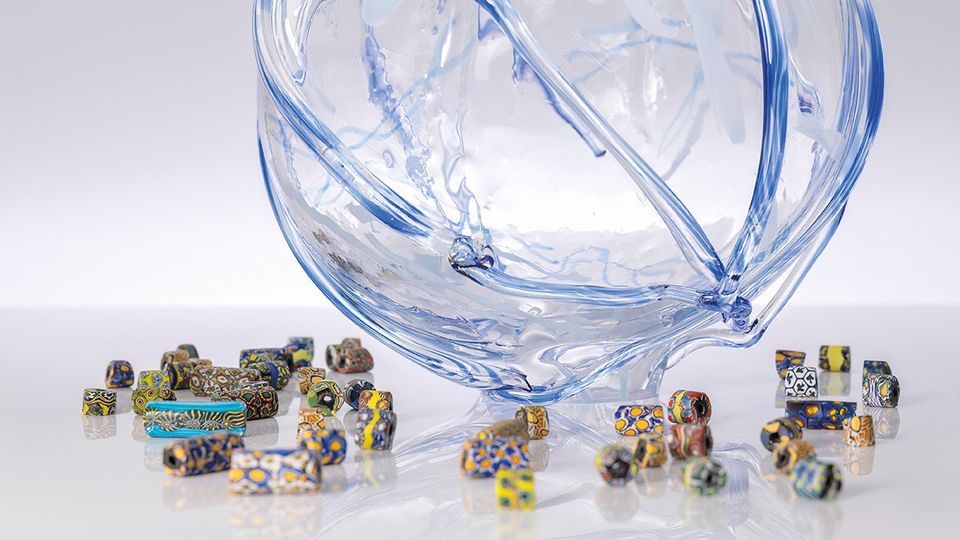
In 2023, the National Glass Museum received a special bequest from Mr and Mrs Eric and Marion Crince Le Roy-Tiets (1948/49–2022). It comprises a large and rich collection of glass beads from all manner of periods and from every corner of the globe, with an emphasis on those traded in Indonesia and Egypt. Until recently, the National Glass Museum possessed only a single Art Deco glass bead necklace. Thanks to this donation, a major gap in the collection has been filled, and for the first time the museum is able to explore the multifaceted history of the bead through its own collection and showcase it to the public.
Collection
Glass beads have been made since ancient times…
In 2023, the National Glass Museum received a special bequest from Mr and Mrs Eric and Marion Crince Le Roy-Tiets (1948/49–2022). It comprises a large and rich collection of glass beads from all manner of periods and from every corner of the globe, with an emphasis on those traded in Indonesia and Egypt. Until recently, the National Glass Museum possessed only a single Art Deco glass bead necklace. Thanks to this donation, a major gap in the collection has been filled, and for the first time the museum is able to explore the multifaceted history of the bead through its own collection and showcase it to the public.
Collection
Glass beads have been used since ancient times as decoration, a medium of exchange and amulets. Around the world, beads were produced in a variety of ways, including techniques closely related to glassblowing. The production of certain types of glass beads was region-specific. Due to their size, beads were easy to export and were in demand on every continent. Via international trade routes, they found their way to every corner of the world. This reveals ancient connections between people and cultures, and demonstrates the influence of one culture on another.
Throughout the centuries, beads have served countless purposes. They provided protection against evil, signified social status and symbolised power and wealth. They were also used as ritual objects, a means of payment and as commodities. Naturally, beads were also popular as decorations for hair, the body, clothing and interiors. The bead thus evolved into a versatile object that found its way into a wide range of interior design and applied arts.
Contemporary experiment
For this exhibition, the National Glass Museum has invited Chequita Nahar (1970), Esther Jiskoot (1963), Jorge Mañes Rubio (1984) and Regula Maria Müller (1961) to its glassworks. This unique legacy serves as inspiration, and drawing on their own artistic practice, they are giving new impetus to creative research into the significance and possibilities of beads.
When
- Daily from 21 November 2026 to 18 April 2027