
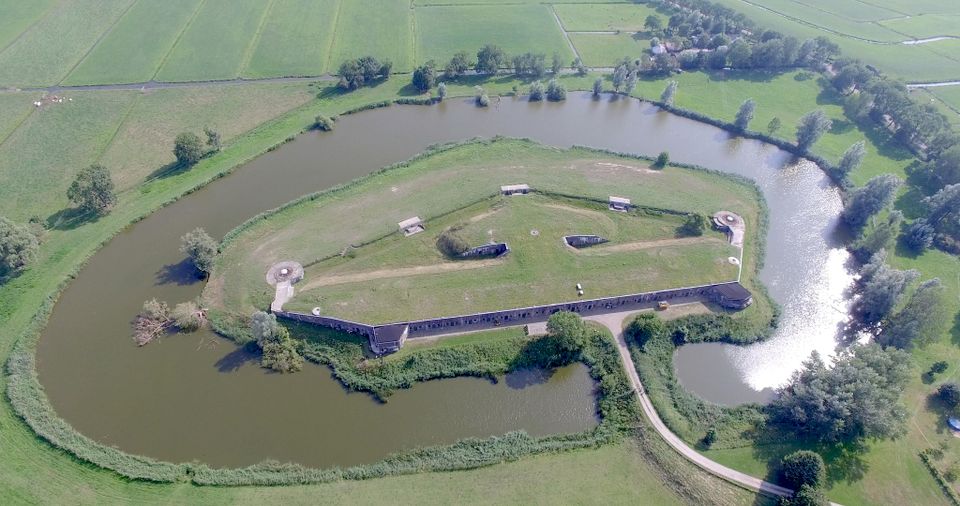
The Fort along the Winkel was constructed in 1895 as a defensible earthwork. As was customary, a body of sand was first constructed on the fort site, which caused the soil to settle. Only five years after the sand body was laid, the soil was considered sufficiently stable to build a concrete fort. To still have a defence around the capital in the meantime, the sand body was initially set up as a defensible earthwork. The construction of the concrete fort would then take place later. However, the inundation area in front of the Fort aan de Winkel was so well defensible that the construction of the concrete fort had very low priority.
After the First World War, the...
The Fort along the Winkel was constructed in 1895 as a defensible earthwork. As was customary, a body of sand was first constructed on the fort site, which caused the soil to settle. Only five years after the sand body was laid, the soil was considered sufficiently stable to build a concrete fort. To still have a defence around the capital in the meantime, the sand body was initially set up as a defensible earthwork. The construction of the concrete fort would then take place later. However, the inundation area in front of the Fort aan de Winkel was so well defensible that the construction of the concrete fort had very low priority.
After the First World War, the usefulness of the Defence Line of Amsterdam was increasingly questioned and eventually the construction of the fort was abandoned altogether. The construction of the Fort on the Winkel therefore stalled at the stage of a defensible earthwork, consisting of a number of earthen ramparts without a concrete fort.