
Fort near Asperen

Location
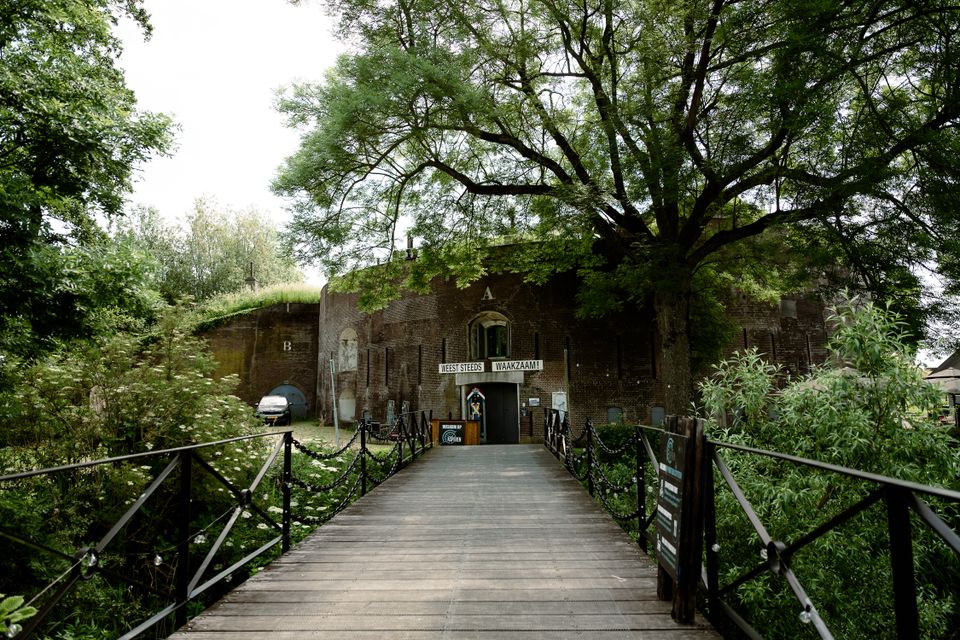
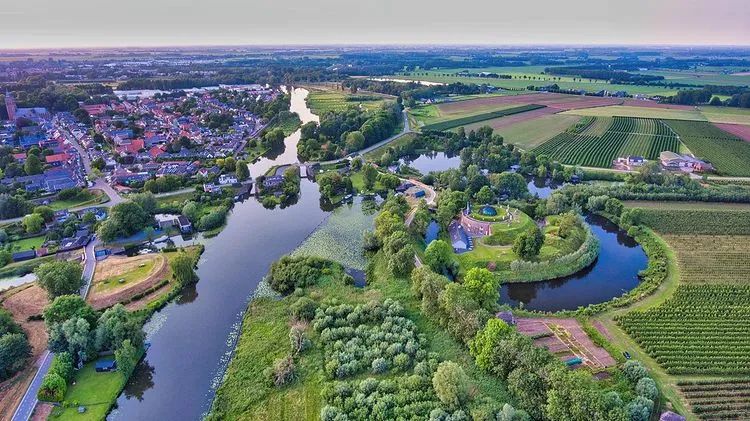
This 19th-century stronghold is a striking beacon in the line landscape. The beautiful tower fortress is military heritage and part of the New Dutch Waterline. Beautifully situated along the Linge river, the fort immediately catches the eye because of the glass dome over the light shaft: a work of art that keeps rain out, but allows bats to find their way to their winter quarters. The dome consists entirely of glass slates developed in the glassworks of the National Glass Museum. As many as 600 children from the neighbourhood were allowed to decorate their own tiles.
tile of their own.
Fort Asperen: Link in the Waterline
Between 1845 and 1847, here, on the border between Asperen and Acquoy, the Fort near Asperen was built as part of the New Dutch Waterline. The fort took the form of a...
This 19th-century stronghold is a striking beacon in the line landscape. The beautiful tower fortress is military heritage and part of the New Dutch Waterline. Beautifully situated along the Linge river, the fort immediately catches the eye because of the glass dome over the light shaft: a work of art that keeps rain out, but allows bats to find their way to their winter quarters. The dome consists entirely of glass slates developed in the glassworks of the National Glass Museum. As many as 600 children from the neighbourhood were allowed to decorate their own tiles.
tile of their own.
Fort Asperen: Link in the Waterline
Between 1845 and 1847, the Fort near Asperen was built here, on the border between Asperen and Acquoy, as part of the New Dutch Waterline. The fort took the form of a semicircle with a bombproof artillery tower and a moat with a drawbridge around it. With its strategic location on the dike along the river Linge, the fort guarded the passage and the sluices in the river Linge. A few years later, the tower moat was filled in and a gun depot with a gunpowder and projectile magazine was built in the basement. Fort near Asperen was last readied for the upcoming war on 12 April 1940. But the fort no longer had much use. The Germans flew their planes over the line.
The Fort near Asperen can be visited during the summer months. Get a guided tour from the volunteers in the tower fort and listen to their fascinating stories about the Hollandse Waterlinies at this spot. Recently, the tower fortress also houses the Sky of Hope museum with stories from WW2. From mid-October to mid-April, the fort is closed due to the bats' winter quarters. The fort's Genieloods, which houses the restaurant, is open all year round for lunch, drinks or dinner.
Armoury
Opposite the fort is the Wapenplaats; a small 0.8-hectare fort on the Zuiderlingedijk near Asperen. The fort has a semi-circular earthen wall and is largely surrounded by a fort moat. The public road runs right through the fort, interrupting the rampart on the south side. Such an opening is called a coupure. There are two buildings in the armoury: a reinforced concrete group shelter from 1939-40, in which 11 men could take shelter from enemy fire. And a Nissen hut from 1950; an oblong shed with semi-circular corrugated iron roof.
North of the Armoury is a unique double fan lock, part of the lock complex at Asperen. The Armoury served to defend this lock, the Linge and the Zuiderlingedijk. Together with Fort Asperen, Fort Vuren and Fort Nieuwe Steeg, the fort formed a link in the New Dutch Waterline.